WINSTON WILDE
Psychotherapy is the professional care of another by a qualified provider.
This care is provided through the use of talk and communication.
Ancient Greek: psyche (soul) therapeia (healing)
About:
I am licensed as a MFT (Marriage and Family Therapist) in the states of California (MFC39060) and New Mexico (CMF0184921). Most of the work I do is insight-oriented customized psychotherapy with sexual minority people. Insight-oriented means a focus on the client expanding their awareness or consciousness, through a variety of therapeutic interventions. Customized means that each client is different and would benefit from interventions from a variety of schools of psychology and other domains of interest, not just one cookie cutter approach for every client. Psychotherapy means caring for the well-being of another. I do insight-oriented customized psychotherapy with erotic minority people. These folks include, but are not limited to: BDSM kinkyfolk of every gender and orientation, modern couples (lifestyle, swingers, open marriage), poly-folk (of every faith or of no faith), fetishists and paraphiliacs, minor attracted persons, sex workers and sex industrialists, gays, lesbians, and our bi tribe. Many clients have reported to me feeling judged by psychotherapists who don't really understand erotic minority people. And countless times I've heard that in years of treatment with previous therapists, they never once discussed sex. You can talk to me about sexuality concerns as much as you want to: it's my field of expertise.
Style:
The style of psychotherapy I do (my theoretical orientation) is what many therapists refer to as eclectic. This eclectic method of psychotherapy incorporates differing schools of psychology into a special blend to suit each client's needs. The therapist and patient can collaborate on what strategies for treatment may be most beneficial.
My work has a strong foundation in the Humanist and Existential schools of psychotherapy, a client-focused energy dynamic. With unconditional positive regard for the clients' journey and for actualizing their full human potential, we work at accepting and honoring what is manifesting right here and now. In this paradigm the therapist may challenge the client to view their situation from a different, or expanded perspective. This alternate view may be disturbing, as it is intended to disrupt the client's familiar but problematic story. This method of psychotherapeutic communication is enhanced by the compassion teachings of Virginia Satir; various faith traditions, especially Hinduism and Buddhism; and current research into neuroscience.
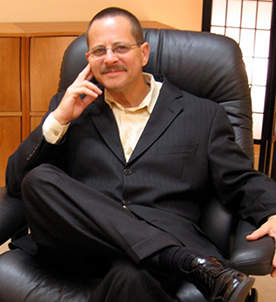
Photo by Hernando Chaves, 2009
There is a framework of Psychoanalytic, or Object-Relations throughout my work. My supervisor was a Holocaust survivor who was very old-school. This psychoanalytic lineage comes from Sigmund Freud, and has evolved into object-relations and Self Psychology. Through good enough witnessing by the therapist, the client can achieve a corrective emotional experience. In this modality, psychoanalytic interpretations are made by the therapist to the client which, if well executed and received, can have a profound effect for the client. This psychoanalytic method can work well with Humanist/Existentialism by utilizing the patient/therapist relationship as a catalyst for a better understanding of what patterns the client may be employing in their interpersonal relationships.
Occasionally I enjoy working from a post-modern Narrative Therapy paradigm. We all get stuck in our stories, some people looping over and over in their heads. Sometimes we tell ourselves that we are a certain way, even when most others view us differently. We are impermanent beings, always in a state of change. To adapt, we all need to get some new stories going on, and to remember that it's okay to have more than one person and more than one story in you. I promote my clients engaging "Multiple Personality Order" (William Henkin). For example, I know a woman who is a professional executive, a soccer mom, and a kinky sub all in the same day. In utilizing Narrative therapy, we look for exceptions to problem saturated stories. This is a collaborative approach which can create unique outcomes.
For the more inspirationally inclined clients, the bhakti yogis and pagan-mates, our work can include teachings from these traditions: mindfulness practice, mantra devotion, and creating ritual.
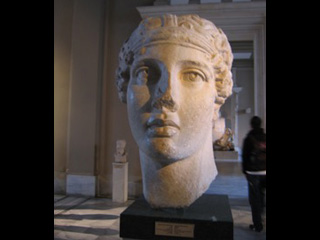
Sappho
National Museum of Archeology, Istanbul, Turkey, 2007
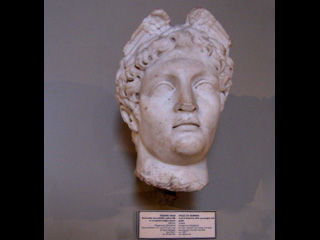
Hermes
National Museum of Archeology, Istanbul, Turkey, 2007
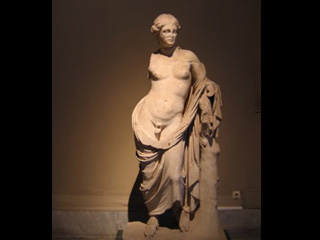
Hermaphroditus
National Museum of Archeology, Istanbul, Turkey, 2007
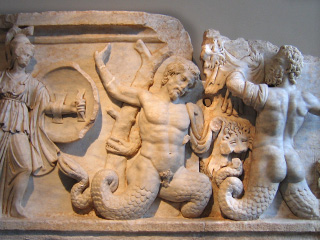
Mermen
National Museum of Archeology, Istanbul, Turkey, 2007